
Architectural Audio: The Category That Doesn't Exist Yet
A discipline is forming at the intersection of acoustics and architecture — one where sound is not installed, but integrated. Here is what it is, why it matters, and what it asks of designers.
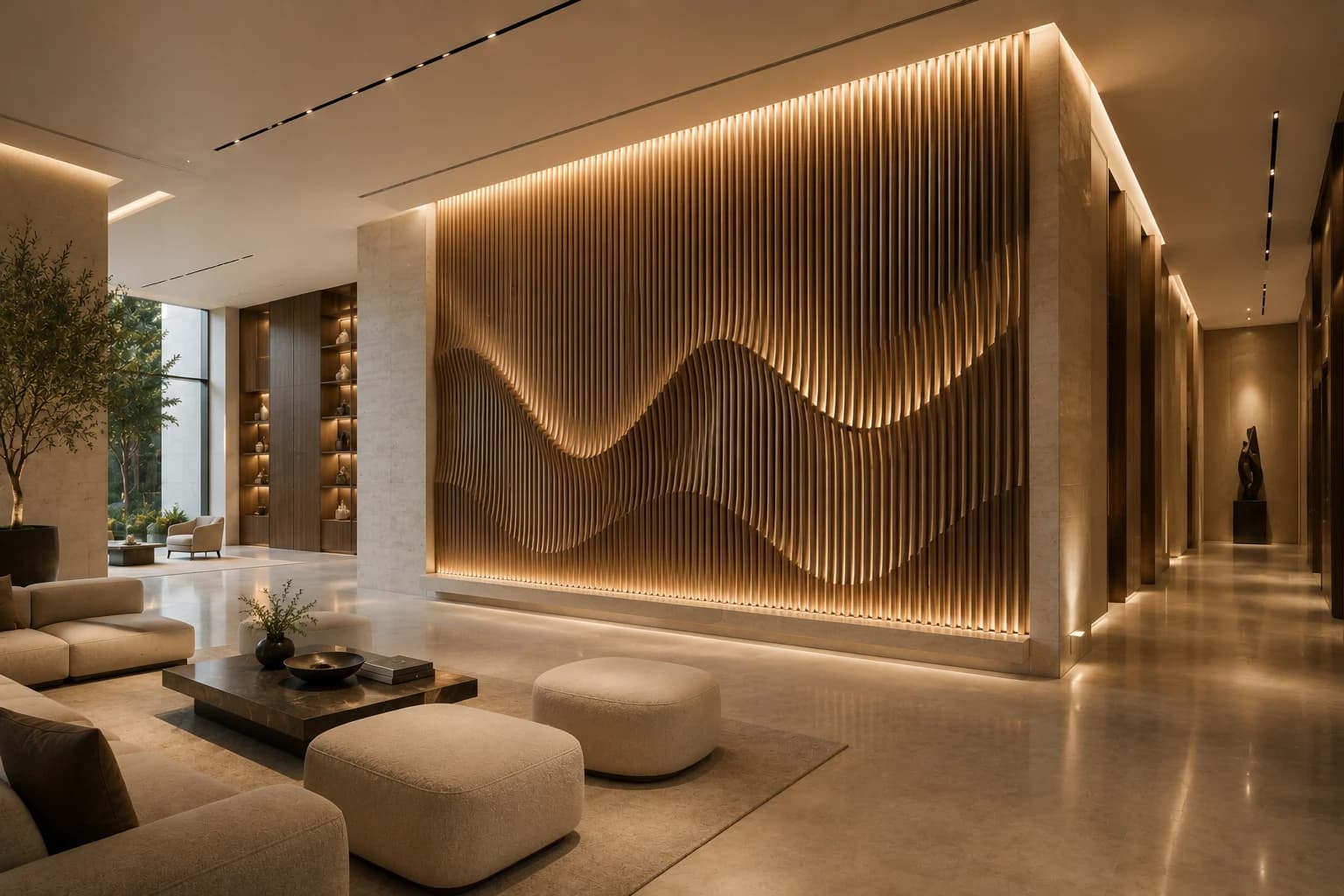
Ask an architect to describe the audio system in a completed project and the answer tends to arrive with a small apology. There were speakers in the ceiling. Or grilles set into millwork. Or a rectangle of black fabric behind a plant. The system worked. The architecture worked. They rarely acknowledged each other.
This article is about a different arrangement. It has been practised for years by a small number of studios, prescribed by an equally small number of designers, and — until recently — has lacked a shared name. We call it architectural audio. The label matters less than the shift it describes: sound treated as a building material, not as equipment brought in at the end.
What follows is a working definition of the category, an honest account of what it can and cannot do, and a look at where it belongs in contemporary design practice. It is written for architects, interior designers, hospitality developers and the technical consultants who advise them.
The Vocabulary Problem
Search the phrase most people use — "invisible speakers" — and you will find a mature commercial category. Speakers plastered into drywall. Speakers hidden behind acoustically transparent skims. Speakers that vanish visually but remain, in every meaningful sense, speakers. They project sound from a point behind a surface toward a listener in front of it.
That is not what architectural audio describes. In architectural audio, the surface is the source. A wall does not conceal a speaker; the wall becomes acoustically active. A ceiling does not host a driver; the ceiling emits. The physics are different, the perceived experience is different, and — crucially for design — the constraints on the space are different too.
The vocabulary problem is not academic. Designers who reach for the phrase they know — "hidden speakers", "in-wall speakers", "concealed audio" — end up sourcing products that solve a different problem. They get invisibility. They do not get integration. And integration is the point.
“A wall does not conceal a speaker; the wall becomes acoustically active.”
Where Speakers End, Architecture Begins
A traditional loudspeaker is a small object designed to move air in one direction. Its performance depends on the room around it — reflections, standing waves, listening position — but the object itself is engineered as a discrete unit. Architectural audio inverts this. The building surface is engineered, quietly, to behave as the acoustic source.
The mechanism is not new in the abstract. Panel-based sound radiation has been studied for decades and used in specialist applications long before it became commercially available at scale. What is new is the design ambition around it: pairing the physics with materials, finishes and installation methods refined enough that a room remains, visually and tactilely, entirely itself.
When it works, three things follow. First, sound appears to arrive from everywhere and nowhere at once — an even distribution rather than a directional beam. Second, the reflective character of the room becomes an asset rather than a problem to be treated. Third, the design language of the space is not interrupted by an acoustic layer. No grille. No baffle. No dark rectangle to disguise.
The Physics, Made Invisible
Every implementation of architectural audio has to solve the same problem: how to transfer a controlled vibration into a large, non-uniform surface without producing distortion, without over-heating, and without demanding constant tuning. The specific technology matters less to the specifier than the operating envelope.
A well-designed system will draw modest power — often measured in tens of watts, not hundreds. It will require no visible hardware in the finished space beyond, at most, a discreet volume control. It will accept a range of surface types — plasterboard, stone, wood veneer, upholstered panels — with appropriate calibration. And, in the honest description of any manufacturer worth engaging, it will have limits: bass extension is different from a subwoofered room; extreme SPL is not the purpose.
Vibroacoustics is the family of techniques we happen to use. Other approaches exist. In every case, the point of the physics is to disappear. The technology is the means; the experience — sound that seems to belong to the room rather than to a device inside it — is the end.
What Architects Actually Ask For
In practice, a specifier rarely arrives at this category by searching for it. They arrive by describing a problem. A residential client who wants music throughout a villa without any object indicating that a music system exists. A hotel developer whose brand promise depends on rooms that feel like private residences rather than technology showcases. A spa operator whose experience design cannot survive the visual noise of grilles above a treatment bed.
The initial brief is usually phrased in the negative: no visible speakers. What we tend to hear more precisely, in a first conversation, is a positive brief hidden inside the negative. The client wants a room that reads uninterrupted. They want architecture without an appendix.
Recognising this shift — from hiding equipment to removing it as a category — is the practical work of adopting architectural audio. It is not a product substitution. It is a design decision made early enough that the coordination with drywall, structural, MEP and finish trades can happen calmly rather than as a retrofit.
Where the Category Belongs
The most obvious applications are the ones already forming a track record. Luxury residential — villas, penthouses, private wellness rooms — is where architectural audio was first prescribed by designers looking for uninterrupted surfaces. Premium hospitality followed shortly after: guest suites, spa environments, wellness circuits, and the increasingly quiet common areas of five-star properties. Fine dining rooms, luxury retail environments and architectural feature installations round out the current shortlist.
None of these applications require the technology in any absolute sense. They benefit from it when the design ambition of the space would otherwise be compromised. The test is whether a visible speaker — however discreetly finished — would register as an interruption. If it would, the case for architectural audio is real. If it would not, more familiar tools remain perfectly adequate.
Eight environments where HST is currently deployed, with reference to the design constraints each solves.
A Category That Predates Its Name
What we now call architectural audio has a longer lineage than the phrase suggests. Cinema sound has, for decades, treated the screen as an acoustic source. Concert halls have shaped structural surfaces to distribute sound rather than direct it. Traditional Japanese architecture uses paper walls as acoustic diffusers by intention. Sound has been integrated into building fabric for as long as buildings have been designed with sound in mind.
The contemporary shift is not conceptual. It is operational. Materials and methods now exist to bring this thinking into rooms that were previously the domain of consumer audio: private homes, hotel suites, treatment spaces. The category is being formalised in the same way that lighting design was formalised in the 1970s — first as specialist practice, then as an expected discipline within any considered interior.
That comparison is instructive. Lighting design did not replace architects or interior designers. It gave them a specialist to consult early, and a language to describe an aspect of the environment that had previously been resolved by chance. Architectural audio is on the same path, at an earlier stage.
What This Means for Design Decisions Today
For a project currently in schematic design, three practical shifts follow from taking the category seriously.
- Coordinate audio with the finishes package, not the AV package. The relevant collaborators are the architect, the interior designer and the plasterer — not the electrical contractor working from a speaker schedule.
- Specify surface, not object. The line item on a drawing set becomes a treated area — a wall from grid line 3 to grid line 7, a ceiling zone, a millwork face — rather than a fixture at a coordinate.
- Decide once, early. Because the intervention becomes part of the surface, retrofit is possible but costlier. The right conversation is the one held before the first coat of plaster.
The reward for these three shifts is a room that reads clean, sounds thorough, and asks nothing further of the design language. In our experience, the discipline of removing a category — audio equipment — from the visual vocabulary of a project has a knock-on effect on everything else. Fewer visible services. Fewer post-hoc compromises. A calmer finished environment.
The four-part process — amplifier, patch, surface, sound — described without diagrams a client would rather not read.
What differentiates our implementation from adjacent technologies and from conventional invisible-speaker products.
The cornerstone reading for hospitality developers and operators. What the category delivers in guest suites, spa environments and signature dining.
The operational guide for architects and interior designers adopting the category on a live project — brief writing, timing, coordination, checklist.
The Honest Limits
A category worth adopting is a category worth describing accurately. Architectural audio, as currently practised, is not the right answer to every audio brief. Dedicated media rooms designed around a cinematic front-stage remain the province of traditional loudspeakers. Concert-level SPL in large volumes is not the target. And any surface treated for sound has to be treated for it — the intervention is not invisible to the trades, only to the eye.
None of this is a caveat. It is the shape of any specialist discipline. Understanding where a category applies is the same skill as understanding where it does not, and the honest presentation of both is, we think, part of the tone the category deserves.
A Quiet Note in Closing
The best-integrated technologies are the ones the finished environment does not announce. Underfloor heating replaced radiators for reasons that were initially technical and ultimately architectural. Recessed lighting displaced pendants in most modern rooms for the same reason. Sound is moving in the same direction, more slowly, and later than it should.
If your current project has a room where a speaker would look like a mistake, the category discussed above is worth a conversation. Not because it is new, but because it makes possible a room that has, for a long time, been almost possible.
The category is easier to hear than to describe. A short listening session is usually the fastest way to decide whether it belongs in a given project.
Questions we're usually asked
- How is architectural audio different from invisible or in-wall speakers?
- Invisible and in-wall speakers hide equipment behind a surface. Architectural audio makes the surface itself the sound source. The result is even distribution rather than a directional beam, and no visible or acoustically transparent grille to design around.
- What kind of surfaces can be used?
- Plasterboard, stone, wood veneer and upholstered panels are all viable, subject to appropriate calibration. Each material behaves differently and is addressed during design coordination, not on site.
- When in a project should architectural audio be specified?
- As early as schematic design. Because the intervention becomes part of the surface, decisions made before finishes are ordered save cost and preserve design intent. Retrofit is possible; early specification is preferable.
- Is it appropriate for a dedicated home cinema?
- Not as a substitute for a cinematic front-stage in a treated media room. Architectural audio is well-suited to living areas, hospitality environments, spas and residential rooms where a speaker would visually interrupt the design. Media rooms benefit from familiar loudspeaker configurations.
- How much power does the system draw?
- Typically tens of watts, not hundreds. Efficiency is a design consequence of the physics: less energy is spent moving a small object and more of it does acoustic work at the surface.
- What maintenance is required?
- Minimal in normal use. The amplifier is standard equipment installed in a service space. The surface treatment is passive and, once installed, requires no routine servicing.
This piece is the first in a series that treats architectural audio as a design discipline, not a product category. Subsequent articles will cover hospitality environments, residential integration, the specifier's brief, and the honest comparison with traditional loudspeakers.
Why architects choose vibroacoustics
The specifier's brief has changed. Clients want music through the entire villa and nothing on the wall to indicate a system exists. The category that answers that brief is architectural audio — and the technology beneath it is vibroacoustics. Here is why the decision usually goes that way.
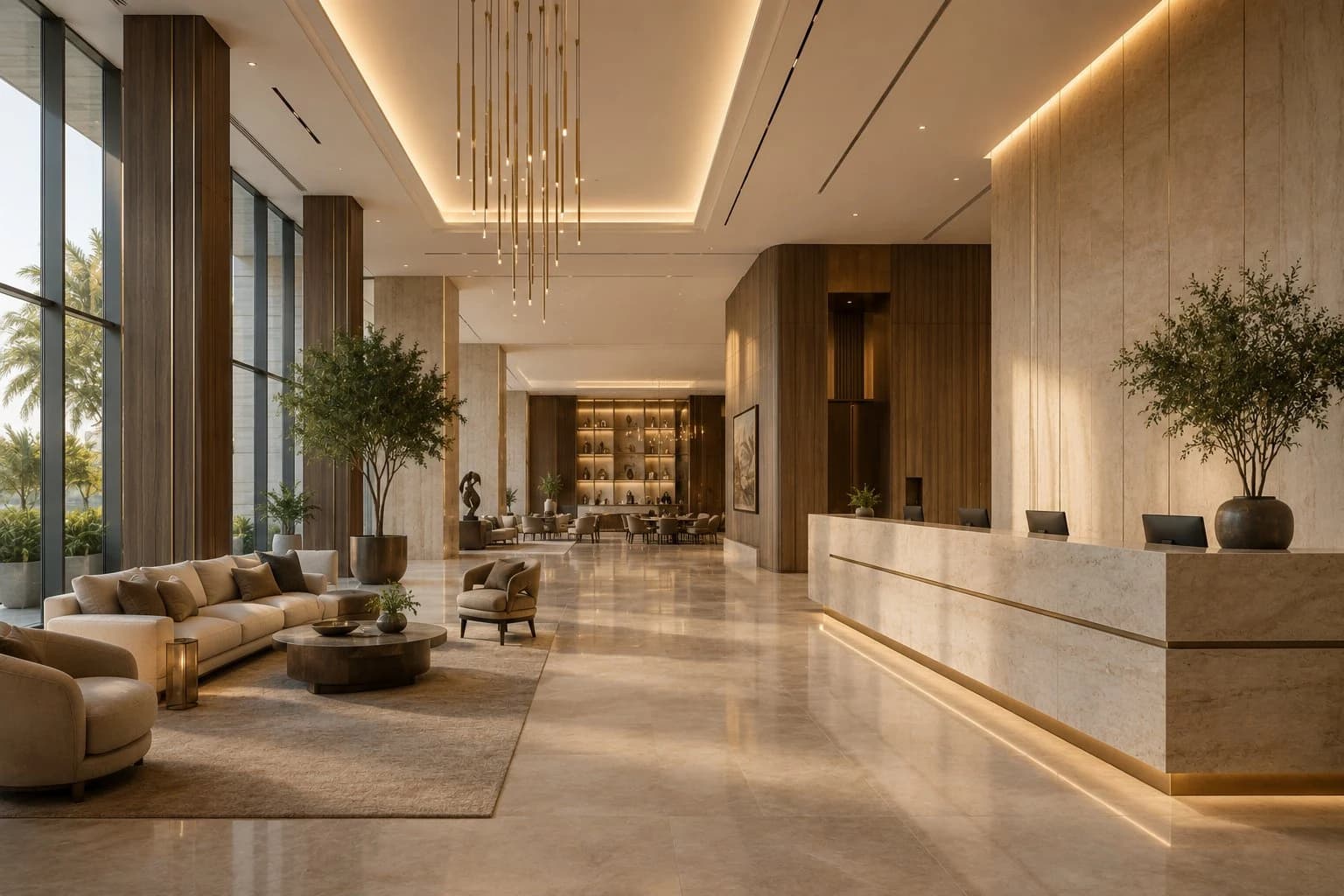
Luxury hospitality audio design — the working brief for 2026
Boutique properties, five-star refits and wellness-forward hotels have moved past hidden ceiling speakers. What the working brief for hospitality audio now asks for — and how the category we call architectural audio answers it, room by room.